| site search by freefind | advanced |
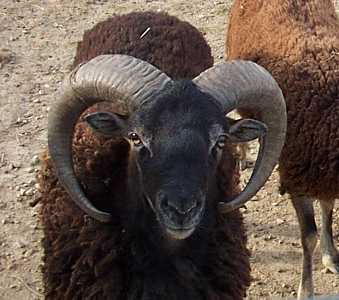
Soay Sheep are a very rare, very hardy, landrace sheep. They tend to look like miniature Bighorn Sheep. They are the oldest European sheep, and predate the division of Wool and Hair Sheep. They were a common livestock during the Bronze Age, but became less favored when the economies demanded larger carcasses and fleeces. Currently they are native to a few islands off the coast of Scotland, and are raised as livestock by homesteaders in at least Europe and North America.
They can be sheared, and have good wool for hand-spinning, but don’t need to be sheared, since they do a combination of shedding and scraping it off themselves, on trees and fenceposts. The rams almost always have horns, the ewes are usually polled, and they do not require tail docking or disbudding. Hoof growth is slow enough that since I made a rock lined corridor that they have to traverse on a daily basis, after four years, I have not had to trim their hooves at all.
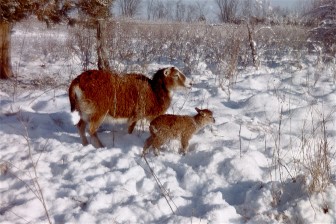
They are born small, as singles and twins, at about 2-3 pounds, and grow quickly. Adult weights are usually 60-90 pounds by about 6 months. Ewes tend to first lamb by the age of 12-18 months, and the rule of Soay, is the only tools you should need during lambing season is a pair of binoculars. I have heard no reports from other breeders of losing a ewe due to lambing problems. Both the Ewes and the Rams tend to be protective of the flock, and there is normally no need to separate the lambs, ewes or rams in any way.
Their lifespan in captivity is usually at least 10 years. Their diet is more that of a browser, than a grazer and they do well on scrubby pasture, but can get kidney stones if fed high protein feed, like alfalfa. They are also more susceptible to copper toxicity when mineral supplements are used. They tend to flock loosely, but usually stay within sight of each other. They do not tend to get along well with shepherding dogs, but do well with Livestock Guardian Dogs that don’t try to boss the sheep, such as Great Pyrenees.
Mine have required no worming or medicines, although I do give them treats of whole oats that have been lightly dusted with Diatomaceous Earth. Their meat is very flavorful, closer in flavor to elk, and does not seem to leave a film in your mouth, like the grocery store "lamb". They have been used for meat, wool, pasture reclamation, pelts, taxidermy and hunting preserves.
I want to order a pregnant ewe bred to certain ram X:They appear to have loosely formed 3 separate flocks that mingle at feeding and separate at other times. One ram seems to be the head of one flock of 10-20 ewes and their nursing lambs. There is a second smaller flock of the remainder of the ewes with their lambs. There is a third flock of only a couple ewes without lambs and the adolescent rams who are not alphas. Our Soay seem to have a division of labor between the matriarch ewe and the alpha ram. The matriarch appears to determine which pasture the sheep will go to at any given time. She will eat and call to the others and the rest tend to follow. The alpha ram seems to coordinate the matriarch's orders and stands guard. He often will eat last, making sure that the others are taken care of. Between the fighting for dominance and the fasting while on guard duty, the alpha ram can start to get lean by the time the lambs are a couple months old. By then, the lambs seem to know what to do and the alpha will take it easy for a few months simply eating and resting until it is time for the rut.
We raise our Soay as a true wild flock. They are not penned separately, so we can not be 100% certain every time which ram sired which lamb. Since we don't catch them to do any urine or blood tests, we also could not guarantee whether a given ewe were pregnant or not. Generally, ewes will be pregnant in the Fall to Winter and lamb in late Winter to Spring, but this is a statistic. Statistics are meaningless when it comes to an individual. Whatever happens to an individual is 100% for them, regardless of the odds.
The rams fight it out on their own. I think this is the way nature intended. When people start selecting for one trait, they can be selecting against some other beneficial characteristic. I think the sheep are better at determining who should breed, but few seem to agree with that sentiment. In my opinion, the biggest advantage of Soay is that they are still wild enough that the "hands off" approach works. If you want happy, healthy, and for the most part, care free animals, this is the way to go. If you want to mess with things and keep logs and have to be there when they lamb and bottle feed the lambs and dock their tails, disbud their horns, shear them and meticulously ration their diet, then there are plenty of other breeds that have been so inbred that they need that kind of care to survive.
We don't castrate, so any rams will be intact. By years of observation and conformation we have a good idea of which of the 4 maternal lines a given animal comes from. By the same token, unless an ewe is nursing right then, we can't necessarily be 100% sure which lamb is from which ewe. Since we are not willing to lie about an animal's ancestry for purposes of genealogy, and there are no registering bodies that recognize a true wild flock system, we cannot offer papers. The only sheep we've ever had are all from registered Soay, American Soay ewes bred to unrelated British Soay rams.
The Silence of the Rams:Due to our health, we cannot usually transport the animals. The buyer will need to arrange for transportation. If you are getting fewer than four, you can bring large dog kennels and put one sheep per kennel in the back of a standard bed pickup. Many hatchbacks can hold 2 kennels with the back seats folded down. If you are driving a long distance or need to put more sheep in a given area, then you will want a trailer.
You'll need to bring a way to feed and water the sheep for the trip. Averaged out, if there is nothing to forage, and only free choice baled hay available, one adult Soay ram or nursing ewe seems to eat about 5 pounds of dried hay per day spaced out into about 5-6 feedings. You will also need harnesses to tether them inside the trailer or what is better is some sort of internal gate separated from the back gate so that those that have been already loaded can't try to charge past you as you load subsequent animals. If you use tethers, the recommendation is to only have them tethered during loading, not during transport. This is so that they don't jumble about, crossing the tethers and possibly getting choked in the process. In the past it has always worked to simply have someone standing at the gate to the trailer and the already loaded sheep would just hide in the back, but you know what they say about an ounce of prevention.
I've heard reports of them jumping a four foot fence, but have never seen that. I have pig excluders on some pasture gates and have had to shorten the excluders down to just over a foot high otherwise some of them balk at jumping the pig gate. Our fences are cattle panels which are 52 inches high and the only time we've had any get out was when someone cut the clips binding them to the posts and effectively opened a new gate. Some of the sheep got out, but none went missing. They seem to be able to recognize certain people and don't just follow anyone.
One thing that works very well is if you can put a section of cattle panel braced just inside the trailer gate and cut a small opening big enough for only one sheep, that way they can't stampede and you won't need harnesses. Roughly 18 inches to two feet from the ground, where a vertical and a horizontal rod of the cattle panel cross, cut them near each other so that there are four tines pointing to where the welded spot of the two rods was. Next bend the tines back to open a section that previously had been four squares of the panel. That is a big enough opening for one sheep. Just stick their head through and they will climb through the rest of the way, to get to the safety of what will soon be the rest of their flock.
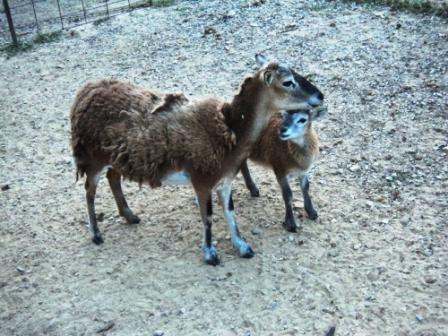
Everyone expects that since the rams are larger than the ewes they will have deep majestic voices. For reasons that are still not clear, this is not the case. I’m not sure if this is peculiar only to Soay or if other breeds exhibit this same trait. The rams’ voices tend to sound hoarse and significantly softer than the ewes’. When we only had one ram we were concerned that he maybe had laryngitis, but after many discussions with other breeders and years of watching them we've found this to be the norm. They sound reminiscent of how a teenage boy’s voice might "crack" while trying to sing. There can be sudden changes in the pitch and octaves such that once you realize that this is normal, then it can sound very amusing.
Soay have only a moderate flocking instinct which means that as they forage they tend to scatter apart. They use their bleating to locate each other to regroup. This is particularly obvious when a new pasture has been opened and the area is densely scrubby or when pastures go around buildings and the sheep can get far enough apart that they can no longer see each other. When they are all together and can see everyone, they can be eerily quiet.
When they do bleat, often the ewes might be described as sounding like drunken pirates belching out a bawdy ballad at the top of their lungs. In contrast the rams’ voices have been described as "namby pamby", "weak" and "piddly".
On the surface some might be concerned that this is in some way a defect, however it is apparent to those who have studied Soay for years that this is not the case. I think it is simply that there has been no selection bias in favor of loud voices for the rams. In their native wild habitat on the islands of the North Sea, there are essentially no predators for the sheep. There, the selection bias has been environmental in terms of their ability to forage, raise their young and survive the harsh winters. In this environment, those who scatter and have a browsing diet will have an advantage over those who flock tightly and have a selective grazing diet which would cause more competition for food. The ewes need a way of locating their lambs to let them nurse, whereas the rams don’t.
Soay seem to have a matriarchal society. The ewes bleat to locate their lambs and to locate the other ewes. When they do this it does not mean that they will necessarily imminently flock together. They seem often to simply be "checking in" to keep track of where everyone has gone and that they are not too far away. The younger rams up to about 2 years of age tend to bleat in reply and flock to the ewes. The older rams tend to merely look around and amble a little closer to the ewes so that they can see them.
With the exception of the alpha ram, (which is determined annually by the battle of the rut) the males more or less seem to simply loosely tag along with the flock and sometimes form their own flock and wander off by themselves. A good alpha ram is a pleasure to watch. He’s a good dad. At the time of writing this, Donder has reclaimed his title of alpha. Our gates look like the rest of the fence and until one is close to an open one it may not look open. When we open different gates to allow access to this or that pasture for a given day. Sheep on one side of the fence will suddenly notice that other sheep are browsing in a greener pasture and they start to alertly stare at them as if to say, "Hey, how did you get in there?" Donder will quietly go back in and appears to maybe even whisper to them and then leads the stragglers to the new area to feed.
Most of this is the same as a pig so see the section in Pot Belly Pigs and then read below for the differences between a pig and a sheep.
Soay are more alert than potbellies so distracting them with grain to shoot them in the head may be more difficult. Also the front and top of their skull is designed for ramming so something like a 22 might ricochet or fail to penetrate the skull. If you are a good shot, you can do the shoot and stick method like a pig. If not; and probably for that reason plus the fact that it is easier to catch a sheep than a pig (sheep having horns and or wool as handholds, whereas pigs have neither); the traditional method to kill a sheep is to cut its throat. You will have to catch it and restrain it first. One thing to remember is that sheep can jump with great force, provided their feet are on the ground. The simplest way to walk an unruly sheep somewhere is with a person on either side of it holding onto either wool or horns, keep the front feet off the ground and let it carry some of the weight by walking on its hind feet. Some people will wrestle it to the ground and while it's on its side tie the feet together. Then with one knee kneeling on the flank and one hand holding down the head, using a very sharp knife in the other hand, cut the throat down to the bone just below the angle of the jaw. You need to cut deep enough to sever the carotid arteries. If you can, cut both sides at once, but given the position you might have to do them in succession. Also remember that the wool can quickly dull the knife so this is a bit harder than it sounds. After the first side, the sudden loss of blood to that side to the brain will result in a stroke within a couple of minutes. Then when it is more docile turn the jaw toward the sky and sever the vessels on the other side. When the blood stops flowing you can begin to butcher.
If you don't have the strength to do this and aren't a perfect crack shot with a rifle, an alternate method is a variant of the shoot and stick method used on a pig. Assuming you are right handed, standing behind the sheep holding onto it's left horn with your left hand, lift the front legs off the ground. Give it a few seconds to stop struggling. Then place a 38 caliber or equivalent pistol loaded with hollow-point ammunition against the back of its skull and fire. The back of the skull is not reinforced and if you use hollow-point ammunition the bullet will shatter inside the skull and probably not have an exit wound. Still take into account the possibility of an exit wound and plan your shot accordingly so that a stray bullet doesn't hit another sheep or anyone else. Firearms, like power tools, need to be understood and respected. The sheep will fall to the ground. Holster your firearm. Then with the sheep on its side, use your sticking knife and stab it in the heart. This will be between the ribs approximately where the elbow is. Again, as with sticking a pig, most of the bleeding with this technique might be into the chest cavity so don't get frantic if you don't see a lot of blood. You will find a large clot in the chest cavity during butchering which you can save for blood sausage or a variety of other culinary uses. If you stuck your knife all the way through the chest from side to side you are going to hit the heart and or great vessels and both lungs. It's dead.
The main differences between a Soay and Potbelly at this point is that a sheep is much easier to skin. Pigs have much tougher skin and far more connective tissue attachments between the skin and the muscle and in particular around the joints. Plus, sheep don't have the layer of armor-like subcutaneous cartilage on the back of the neck. The symphysis (the place on the pelvic bones where the two halves meet in the front) on the sheep is thicker bone than in the pigs, so it is a little harder to split the pelvis. It also tends to work better to cut a wedge out of the bone there. Overall, an adult Soay and an adult Potbelly dress out to roughly the same amount of meat. The sheep have larger hearts and testicles and more developed diaphragms but smaller liver, spleen and kidneys. Like the pigs, we usually save the front legs to barbecue like you would do ribs on a larger animal. The hind legs are saved as roasts, as are the loins. The rest gets processed either into ground lamb or chunks for kabobs or stew meat. The bones get pressure cooked down and canned as stock.
Wild flock management has several advantages. The first is obviously less work, but with less work comes less control. It means trusting in the instincts of your animals to take care of themselves. Soay in particular, as a landrace, as opposed to a highly domesticated breed, lend themselves very well to this approach, since they retain very much their wild behavior.
If you raise your Soay as a wild flock, you may see yourself more as a spectator or rancher, rather than a shepherd. By having a true flock, where the rams and ewes and lambs have 24 hour access to each other, the sheep will dictate who mates with whom and who is the leader, when they will lamb, and what cliques or bonds may form. If the shepherd's desire is to exert their own will on the sheep, or breed to a "desired appearance", this will not be an acceptable approach. If the shepherd's desire is a happy, healthy flock that can take care of themselves whether or not you are present, this will work beautifully.
In starting a wild flock there are some factors that may need to be taken into account. Simply getting a particular breed from several sources may not be enough although it is a good start in allowing for diversified genetics. Rams that have been raised isolated from ewes have been reported to attack lambs. Is this because they were never around the girls, except to mate? and so never learned to be gentle? Or is it that ram's personality in the beginning? Philosophers debate the same question in humans who end up in prison for various acts of misogyny. This means, watch the interactions of the animals and talk to the breeders from whom you are purchasing your flock, before taking them to your farm. A ram that does exhibit overly aggressive behavior may not be in the best interest of your flock.
We have done well by starting our flock with pregnant ewes and not purchasing a ram. The first ram born on our farm has become the dominant ram, whether that is by personality or timing I don't know, but he watches over the new lambs and guards the lambs and their mothers for usually the first month or so after they are born, often in deference to even the temptation of grain. He will even attack anything that he seems to regard as a threat, regardless if that is a boar pig or a dog or a burro much greater in size. I believe he would probably attack coyotes as well since they are much smaller than other animals that I have witnessed him attack. The ewes also have demonstrated cooperative defense. I have seen them, when our ram was a tiny lamb, line up side by side with the lambs behind them when a dog approached and when the dog advanced, the matriarchal ewe attacked, and drove away the dog which was as large as herself.
When you purchase new additions to your flock, you may need to get ewes instead of rams, since if you get a ram, if there are other rams present, there is no guarantee the new one will be the one mating, but it is doubtful a ram would turn his nose up (or rather literally, in the case of Soay, not turn his nose up) to a ewe in heat. This approach will take longer to get the new genetics into the flock, but is more reliable.
After taking into account your animals' personalities, the other thing that must be addressed prior to your flock purchase, is their habitat. If they are to be a wild flock, they must have at their disposal an environment that allows for food, water, shelter and exercise, just as they would require in the wild. I made a rock lined corridor leading to their watering pond which trims their hooves for me. They have rotating pastures of a total (for now) of five acres. Any pasture has some form of shelter, either a barn or woods or both, always with constant access to water.
If you raise your Soay, or any other livestock, as a wild flock your main advantage is they won't need you. You don't have to be there all the time so you could leave for several days and they should be fine (we have a burro in the flock to also act as guard, just to be paranoid). You also will not need a bunch of pens to separate everyone. Castration is unnecessary, since you want the most fit ram to be the dominant and they will determine that, not you.
The main advantage, from the view of the sheep, is a more normal lifestyle, and physically (and probably emotionally) more fit animals. The disadvantage of wild flock management is you won't be able to have a piece of paper that says who is the sire (unless you only have one ram) and your favorite ram might not be the dominant one, so you would find it difficult to be able to selectively breed for any particular physical trait.
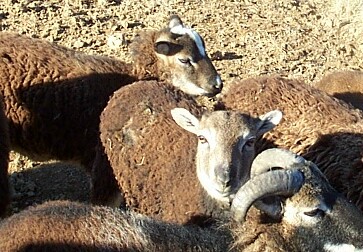
Soays of America has established within our Registry provisions for a Wild Flock system, to enable members to register flocks run in the manner described above. To qualify for registering sheep in a Wild Flock system, all sheep on your farm must be registered with SOA. Once that is completed, any resulting lambs will qualify for registry with SOA. The Registration number for any Soay born into a Wild Flock will have a "W" suffix, to indicate Wild Flock System, which indicates that the sire's information will be "Registered Soay Ram", and the 5-generation pedigree will show the same and no more on the sire's side. Soay sheep registered with SOA and run in a Wild Flock system have equal status and value as sheep run in the Standard Flock System. ©SOA
Ultimately too much inbreeding is a problem for any species. That said, the wider the genetic diversity for a given population, the longer that takes. Livestock breeds that are wilder are less inbred from the start and so have a longer resistance to such effects. On an individual, anything is possible, but from a population standpoint, Soay are not considered a breed, but a landrace, recognizing their closer proximity to being wild. I've only had to cull 2 sheep over the last 15 years for health issues and both times that was due to their horns being tight enough that they had problems getting them locked. In the big scheme of things, that's what you do as a farmer/rancher/shepherd; some will be eaten. Keep the best for breeding and any with identifiable flaws are the first on the dinner invitation list. Generally the recommendation is to start with 2-3 ewes. If they are pregnant, chances are one of them will have a ram lamb. There is nothing wrong with also starting with an adult ram. They will act as a protector. The issue of rams is when adding new sheep to an already existing flock in the Wildflock system. The new ram might not be dominant and so adding him then is basically a waste of resources. If he's the only one, then he's assured of being dominant, at least until a younger ram grows up and displaces him.
I have known of that to happen with shepherds of other breeds. Theoretically there is no reason that it couldn't happen with Soay. However, in every case that I've have personally seen it happen or were able to discuss with the rancher/shepherd themselves, the story was the same. The ram had been habituated to being petted by the shepherd. Rams are sheep. They discuss things amongst themselves by butting. If they regard you as a member of the flock they will try to discuss things with you by butting. Never turn a ram into a pet. Never let him think that you are a member of the flock. That should generally prevent the day to day issues. The aggression or, "rammy," behavior that others discuss regarding rams and why they feel that they have to separate the rams from the ewes and lambs is something that I've never observed with Soay. I have heard about it in other Soay, but in every case that went away when the rams could get back to the flock. How much of, "Rammyness," is specific to other breeds I can't say, but in Soay it seems that isolation from the flock is the main cause. It is also worth noting that in most breeds of livestock, the males run the group and have what is best called a harem. In those groups the lead male is constantly doing some form of forceful dominance to keep the harem from straying and keep the other males at bay. These forceful displays of dominance can result in injuries and even death when applied to the dominated. This is the source for the stories about aggression among rams. That said, most of what we know about sheep is with regard to domesticated sheep. Many breeds of domesticated sheep have been so inbred that they actually have lost entire chromosomes, some as many as half of their chromosomes. These also tend to be the breeds that gave rise to the notions of sheep being so stupid that they could drown in the rain, or were just looking for an excuse to die. These are not representative samples of the species as a whole.
Soay are wilder. Soay have a matriarchal society. The rutting rams fight amongst themselves and decide which of the strongest is allowed to mate. The ewes however get the final say. The ewes who want a big strong duelist and therefore stronger offspring will mate with that alpha. Some ewes prefer a calmer gentler ram and will pick from the rams who do not participate in the rutting duels. There are sometimes pair bonds that transcend the rut. Watching them, it is interesting to see the big rams who failed in the duels watch a smaller ram and his ewe friend together and they are visibly disturbed, but do not interfere.
With regard to protecting the flock if they perceive you as a danger: Remember that rams are sheep. If they have a place to run to, the lambs will run, the ewes will accompany the lambs, the rams will follow. The attacking / protecting instinct kicks in when there is nowhere to run. That is when they should be considered dangerous. If I have to repair a fence in the paddock, I lock the sheep out so that there is no confusion. I only get in the paddock with the sheep when I need to catch one. They generally will snort and stamp their feet either as a warning or maybe just to express displeasure. Another thing to keep in mind is that when they do attack, their preferred method is to have at least a 20 foot charge first. For a Soay's height, assuming their target is a standing adult, that means hitting your leg or maybe even hip. I've not heard of this happening to a person with Soay, but if it were to happen, could easily result in a broken leg or worse, torn cartilage in a knee. The risk is low, but the price of failure is high. Always be aware. Always be vigilant. You might even want to put some blind ending dividers in your paddock so that they can't manage a 20 foot charge. So if you corner them where they have nowhere to back up for that charge, they might try to charge anyway, but won't have nearly the force of a full charge. That's when you can grab them by the horns. They seem to know this and so more likely they will try to run or jump past you. When they do that, they might try to give you a flying head butt or kick you with their hind feet as they fly by. A flying head butt is not nearly as forceful as a ramming charge, but is at about head level for the average adult and can knock you off your feet and daze you for a few minutes, theoretically (anything is possible when you talk about an individual) could result in a broken jaw, concussion etc. A flying kick might land on your abdomen and feel like a strong punch to the gut.
Soay in particular are more prone to copper toxicity. They survived for 1000 plus generations in a copper deficient area, so genetic tolerance of low copper was selected for and there was no evolutionary selection pressure against being overly sensitive to copper. The commercial feed places insist, "Oh, Sheep Need Copper!" Technically yes, however with regard to Soay, they will most likely get enough without having to be supplemented. In this same way, there are some biochemical pathways in humans that are dependent upon cyanide or arsenic or mercury. That certainly doesn't mean that anyone should be taking supplements of them. The commercial places package mineral supplements labeled, "For sheep and goats." Goats are way more dependent on copper and if you give that supplement regularly to Soay, you will kill them. The salesmen at feedlots, agricultural supply stores and mills are just that, salesmen. They want you to buy something. They are not Medical Doctors or Veterinarians. They do not have PhD's in Biochemistry, Molecular Biology, Microbiology, Physiology, Comparative Biology or any other, "ology," that you can think of.
Every area of the world is going to be higher in some minerals and low in others. Your local Agricultural Extension Office will likely have that already mapped out. You might need some mineral supplements and most likely will not be able to find one without copper. I do, in the warm months, about once every 1-2 months use some loose mineral salt and make a thin line of it on the sidewalk along the paddock where the sheep can get to it, but no one sheep can hog it and have not had a problem with the copper in the mineral supplement using it sparingly that way.
We've never had issues with their hooves but to get to the pond to drink, they have to walk through a roughly 150 foot gravel lined fenced corridor. Simply walking on gravel trims their hooves without overdoing it.
Sheep in general are rather sensitive to nicotine and caffeine. Put your coffee grounds in the compost rather than feeding them to the sheep and don't let people drop cigarette butts in the pasture.
Soay will generally browse first and graze second and don't mind hills. They aren't as nimble as goats when it comes to climbing but are definitely better at hills than people. That also means they will browse out and parkify a woods that is overgrown with blackberries, other brambles, poison ivy, wild roses etc. That also means that they will eat your flowers and small fruit trees if they can get to them. If there is enough to browse, they will do well on that. If not then they will need a supplement of some sort. Here, we do not have a reliable source of hay to buy. Seven farmers offered to come out and cut hay on our pastures in return for half of the hay. Not a single one ever showed up. People supposedly bringing hay for us to buy generally also simply never showed up and never called to say that they were not going to show. The others would show up with something very different than what had been agreed upon, usually that meant horribly improperly stored hay. Soay are particularly prone to miscarry if given moldy hay. What we do in the winter is cut cedar trees. About once a week we drive the truck out into the old pastures, cut a roughly 25 foot cedar tree. Tie it to the hitch and drive back and drive it into the pasture. The sheep will eat the greens. After a few days we have to rotate the tree so that the areas that were too high, or too low (squished onto the ground) are now within reach and then repeat at the end of the week. I leave the cedar carcasses in that pasture until spring because they will continue to nibble on the twigs and if worse comes to worse and I have the flu or other health reasons that I can't get out to get another cedar, the sheep will strip the bark and eat that. I also continue through the winter giving them treats of shelled corn to keep them trained in coming to the paddock.